 Skip to content

It starts quietly. A water stain on the ceiling after a heavy storm. An energy bill that climbs every summer despite nothing changing inside the house. Then the roofer’s assessment: your asphalt shingles have maybe three to five years left — and this won’t be the last time you replace them.
For homeowners who have been through one roof replacement already, that moment triggers a different question entirely: what if you installed a roof you never had to replace again? Understanding the types of metal roofing for residential homes is where that answer begins.
Why Residential Metal Roofing Has Replaced Asphalt as the Smart Long-Term Choice
Residential metal roofing refers to any roofing system using steel, aluminum, copper, or zinc panels designed for single-family and multi-family homes. It outperforms asphalt on lifespan, weather resistance, energy efficiency, and total cost of ownership — typically lasting two to four times longer than traditional shingles.
The average asphalt shingle roof requires full replacement every 15 to 20 years (Asphalt Roofing Manufacturers Association). A professionally installed metal roof lasts 40 to 70 years depending on the material — meaning most homeowners who make the switch will never replace their roof again. Over a 60-year ownership horizon, that difference in replacement frequency represents a substantial cost advantage, even when accounting for the higher initial installation cost.
Beyond longevity, the thermal performance of metal is a compelling financial argument on its own. Metal roofing’s reflective surface reduces solar heat absorption by up to 25%, directly lowering cooling loads and monthly utility costs (Oak Ridge National Laboratory). In climates with hot summers and harsh winters — like the northeastern United States — that thermal efficiency compounds across every billing cycle for the life of the roof.
The 5 Primary Types of Metal Roofing for Residential Properties
To help you evaluate the best fit for your home’s architecture and regional climate, here is how the primary residential metal roofing systems compare:
| Metal Roof Type | Average Lifespan | Best Suited For | Key Advantage |
| Standing Seam | 50 – 70 Years | Modern & contemporary homes | Maximum leak resistance with concealed fasteners. |
| Corrugated Panels | 30 – 45 Years | Outbuildings, cabins, & budget builds | Most cost-accessible entry point into metal roofing. |
| Stone-Coated Steel | 50+ Years | Suburban neighborhoods (HOA compliant) | Traditional look of tile/slate with industrial strength. |
| Aluminum | 50 – 70 Years | Coastal areas & high-salt environments | Inherently rust-proof and highly corrosion-resistant. |
| Copper & Zinc | 100+ Years | Historic restorations & luxury custom builds | Generational longevity; develops a self-protecting patina. |
Note: The average lifespans listed above are industry benchmarks based on standard environmental conditions and proper, manufacturer-certified installation. In regions like Massachusetts and the broader New England area, actual roof longevity can be heavily influenced by micro-climates — such as severe winter snow-loads, heavy coastal salt-air exposure, and high seasonal humidity. Additionally, maximizing these lifespans requires the use of high-temperature synthetic underlayments, balanced attic ventilation systems, and routine annual clearings of debris from valleys and gutters.
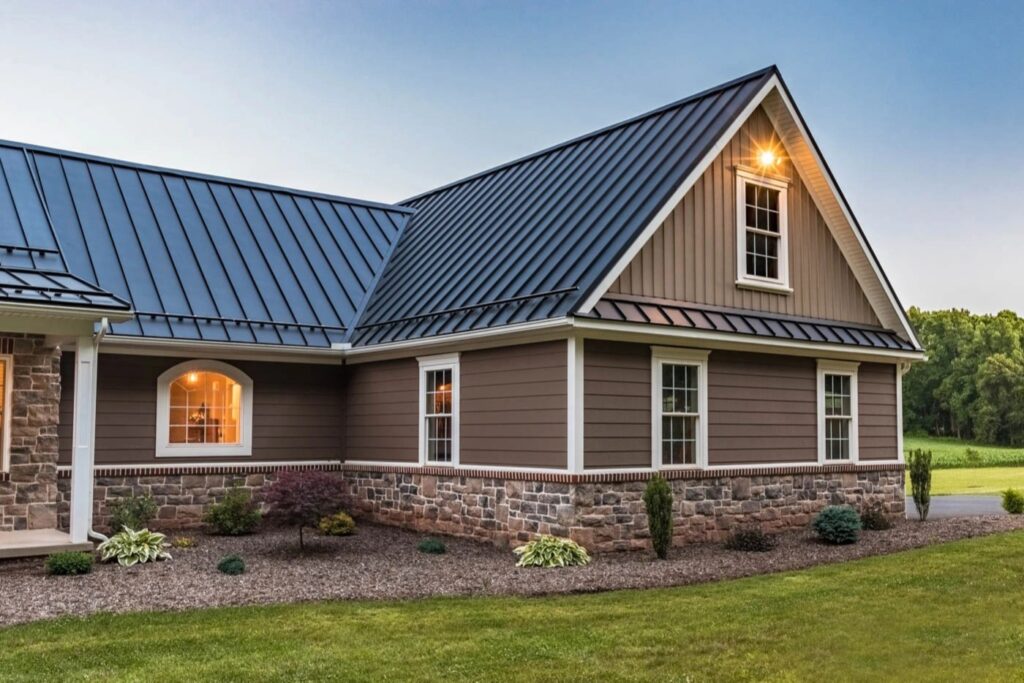
1. Standing Seam: The Gold Standard for Modern Homes
Standing seam is widely considered the premium benchmark of residential metal roofing systems. It consists of vertical steel or aluminum panels with raised, interlocking seams that connect tightly without exposed fasteners — eliminating the most common source of roof leaks in conventional systems.
The concealed fastener design means there are no screws or nails penetrating the panel surface that can work loose over years of thermal movement. The panels are engineered to float on a clip system, accommodating the natural expansion and contraction of metal across seasonal temperature swings without stressing the substrate.
2. Corrugated Metal Panels: Proven Performance at an Accessible Price Point
Corrugated metal roofing — characterized by its wave-pattern profile — has been a proven performer in commercial construction for well over a century. Its resurgence in modern residential design is driven by a growing appetite for industrial-rustic aesthetics and its position as the most cost-accessible entry point into metal roofing.
It is significantly lighter than standing seam, placing minimal structural load on the home’s framing — an important consideration for older homes or additions where load capacity is limited. While its exposed fastener system requires periodic inspection to maintain a watertight seal, a well-installed corrugated system on a correctly pitched roof performs reliably for decades.
3. Stone-Coated Steel: Traditional Aesthetics With Industrial Strength
Stone-coated steel roofing solves a specific problem: homeowners who want the visual character of clay tile, natural slate, or cedar shake — but need the structural resilience that only steel can provide. The system layers high-grade galvanized or Galvalume steel with a factory-applied acrylic film and real stone granules.
The practical advantages are significant. Stone-coated steel is rated for Class 4 Impact Resistance — the highest designation available — making it one of the most hail-resistant roofing products on the market (IBHS). Many insurance carriers offer meaningful premium reductions for homes with Class 4 rated roofing, progressively offsetting the upfront cost over time.
4. Aluminum Roofing: The Definitive Choice for Coastal Environments
Steel, regardless of its coating system, is vulnerable to accelerated corrosion in environments with persistent salt air exposure. Aluminum is inherently rust-proof — it does not require a protective coating to resist oxidation because its natural surface chemistry prevents it. For homes within several miles of saltwater coastlines, aluminum is a practical necessity.
Aluminum is also notably lighter than steel, which reduces structural load and can simplify installation on homes with complex roof geometry. Its one trade-off is that it is softer and slightly more susceptible to surface denting from severe hail than heavy-gauge steel systems.
5. Copper and Zinc: Architectural Metals Built for a Century
Copper and zinc occupy the luxury tier of residential metal roofing — materials specified when the goal is a roof that functions as an architectural statement rather than simply a weather barrier.
Copper develops its signature blue-green patina through natural oxidation over five to seven years. That patina is not surface deterioration; it is a stable protective layer that actually slows further oxidation, contributing to documented lifespans exceeding 100 years (Copper Development Association). Zinc behaves similarly, forming a self-repairing zinc carbonate layer that seals micro-scratches over time.
The True Cost of Metal Roofing: Upfront vs. Lifetime ROI
The initial cost of residential metal roofing runs two to three times higher than asphalt shingles. However, when measured across a 60-year ownership period accounting for asphalt’s replacement cycles, labor cost inflation, and energy savings, metal delivers a significantly lower total cost of ownership.
💰 The Long-Term Math: An asphalt roof replaced every 15 to 17 years means three full replacements across a 50-year period — each at a progressively higher labor and material cost due to economic inflation. Metal installs exactly once.
Furthermore, the 20% to 25% reduction in summer cooling costs compounds annually across the roof’s lifespan. In regions prone to harsh winter weather, metal roofs also offer an unquantifiable ROI by preventing ice dams — the smooth surface allows heavy snow to slide off safely before it can melt and back up under the eaves.
Debunking the Three Most Persistent Myths About Metal Roofs
- Myth 1: Metal Roofs Are Loud in the Rain
This objection applies almost exclusively to metal roofing installed over open framing without solid sheathing, like in old agricultural barns. Residential metal roofing installed over solid OSB or plywood sheathing with a quality high-temperature underlayment and standard attic insulation produces indoor sound levels completely comparable to asphalt shingles. - Myth 2: Metal Roofs Attract Lightning
Lightning is attracted to the highest point in a given area — not to specific materials. A metal roof does not increase lightning strike probability compared to any other roofing material. More importantly, metal is completely non-combustible; in the rare event a strike does occur, it safely disperses the electrical charge without fire risk. - Myth 3: Metal Roofs Dent Easily
While entry-level, thin-gauge corrugated panels can show cosmetic denting from severe impacts, residential standing seam and stone-coated steel systems are highly engineered. Class 4 impact-rated systems are built to withstand two-inch steel ball impacts without structural compromise.
Critical Installation Factors That Determine Performance
The material specification accounts for roughly half of a metal roof’s long-term performance. The other half relies entirely on installation quality — specifically regarding thermal movement management and flashing precision.
Thermal Expansion and Fastening Systems
Metal panels expand in summer heat and contract in winter cold. On a standard residential roof, this movement can measure several inches across a full panel run. Fixed fastener systems that do not accommodate this movement will eventually cause panel distortion or fastener pullout. Standing seam clip systems are specifically engineered to allow this movement smoothly without putting stress on the substrate.
Underlayment and Ventilation
High-temperature synthetic underlayments are mandatory for metal roofing because standard felt underlayments can off-gas and degrade under the elevated heat environment created beneath a metal roof deck. Proper attic ventilation is equally non-negotiable. Without balanced intake and exhaust ventilation, moisture can accumulate and cause condensation to form on the underside of panels.
Flashing Execution
The majority of metal roof failures are not panel failures — they are flashing failures at chimneys, skylights, dormers, and roof-to-wall transitions. These termination points require precise fabrication, correct overlap geometry, and appropriate sealants that remain flexible across thermal cycles. This is why it is critical to select an installer with documented metal roofing specialization rather than a general roofing contractor.
FAQs About Residential Metal Roofing
Can metal roofing be installed directly over existing asphalt shingles?
Yes, in many cases. Installing metal panels over existing shingles eliminates tear-off labor and disposal costs. However, a professional structural inspection must first confirm that the existing sheathing and roof deck are structurally sound and free from hidden rot or moisture damage.
How much does residential metal roofing cost compared to asphalt?
Metal roofing typically costs more upfront installed depending on the material and system type, compared to standard asphalt shingles. However, this cost premium is fully recovered through the elimination of future replacement cycles, reduced energy bills, and potential insurance premium discounts.
Which metal roofing type is best for homes in high-hail regions?
Stone-coated steel with a Class 4 impact rating is the strongest performing option in hail-prone environments. The stone granule surface layer dissipates impact energy more effectively than bare metal panels while the underlying steel core maintains structural integrity.
The Right Metal Roof Lasts a Lifetime — If You Choose Correctly
Every metal roofing system outperforms asphalt in lifespan, weather resistance, and long-term economics — provided the specification matches your home’s unique footprint and the installation is executed by specialists who understand the mechanics of metal.
At Exponential Construction Corp., we guide homeowners through every material decision and install every system to strict manufacturer specifications.
Contact us today for a comprehensive project consultation and free estimate — and make the last roofing decision your home will ever need.